Historian & Author — Freedom and Identity

.png?updatedAt=1721224205728)
How one young girl’s escape from slavery led to a courtroom fight for freedom
What “free soil” meant in the United States before the Civil War
How laws and courts decided who was free—and who was not
The role of courage, choice, and community in the struggle for justice
How Matilda’s case helped shape conversations about freedom and rights
How history connects to identity, fairness, and responsibility today
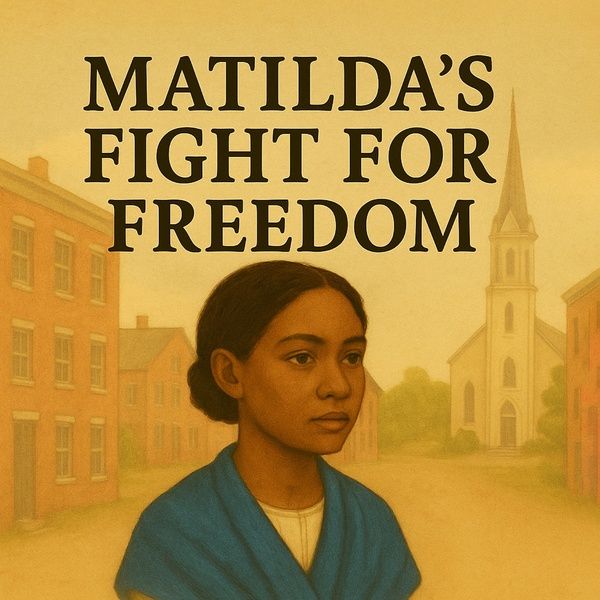
In this opening section of Matilda's Fight for Freedom, I share how I first fell in love with the study of history. You'll discover how one college class changed my life. I wrote my senior seminar paper on Dred Scott, which, decades later, led me to tell Matilda's story.
This lesson will help you understand why history is not just about dates and laws. It's about real people who dared to dream about freedom. You'll discover that Matilda did what no lawyer could do for her: she had the courage to say, "I am free by birth."
By the end of this lesson, you will understand the purpose behind this book. You'll also recognize why Matilda's fight for freedom is still relevant today.
In this opening section, readers are introduced to Matilda Lawrence's early life and the courageous decision that changed everything. Chapters 1-3 follow her journey from quiet strength under slavery to her daring act of self-liberation in Cincinnati, Ohio, a free state. Readers will explore how geography, law, and personal courage met in 1836, and how a single moment of choice opened the door to freedom. This section lays the emotional and historical foundation for the legal battle that followed.
After reading this section, you will be able to:
(Chapters 4–7
This section shows that once Matilda's freedom was challenged, her future moved from the streets of Cincinnati to the courtroom of a Hamilton County Justice of the Peace. Chapters 4-7 explore her capture under the Fugitive Slave Law of 1793, the search for legal defense, and the strong constitutional arguments for freedom made on her behalf. Readers will witness how state and federal law conflicted in 1836 and how the courtroom became a battleground over the meaning of freedom. This section reveals both the limits of the law and the courage required to challenge injustice within it.
After completing this section, readers will be able to:
(Chapters 8–9)
In this chapter, readers examine the results of the court's decision and the lasting impact it had on Matilda's life. Chapters 8-9 trace her forced removal from Ohio. They also show how, instead of hurting his career, Salmon P. Chase became a popular figure in Ohio and national politics. He helped develop the area of antislavery law and held state and federal offices. Matilda lost her case, but it influenced legal thinking about it and strengthened resistance to allowing enslaved people to be brought into Ohio. Thus, this section shows how one act of courage can contribute to long-term legal and social change.
Upon completion of this section, readers will be able to:
No prerequisites required

Historian & Author — Freedom and Identity
.png?updatedAt=1721224061345)


Already a member? login to access
This course includes
.png?updatedAt=1721224061418)






Choose the free account that best fits how you want to use TGD.
Choose the free account that best fits how you want to use TGD.